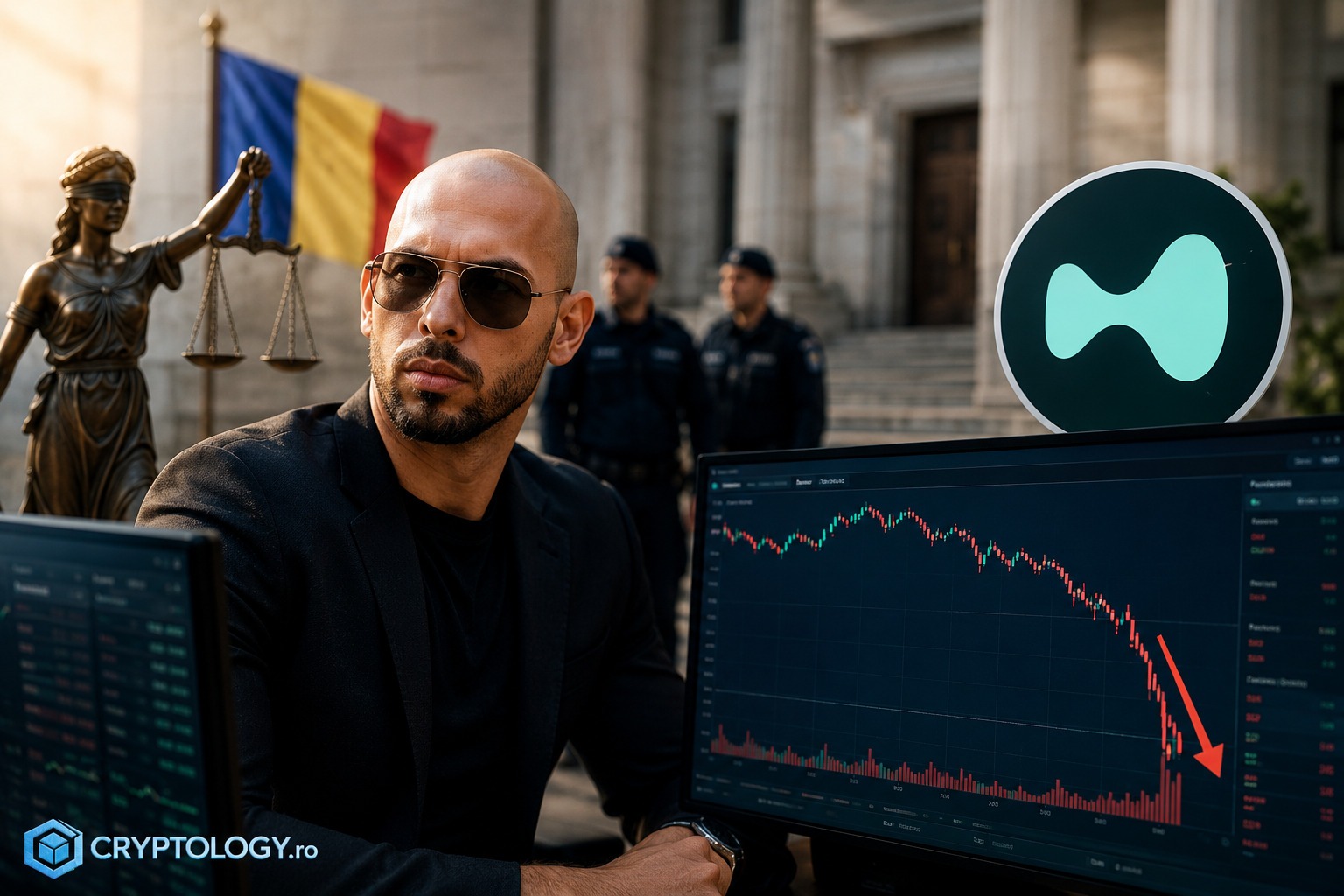

On 17 June 2026, two clocks ran down at once for Andrew Tate. One tracked how long an over-leveraged position could survive on a decentralized exchange before the market wiped it out. The other counted the hours until Romanian prosecutors would pin another charge onto a criminal file that has been growing since December 2022. Both hit zero on the same day.
On the money side, the former kickboxer took his 108th liquidation on Hyperliquid, a perpetual futures platform. On the legal side, the Directorate for Investigating Organized Crime and Terrorism, known by its Romanian acronym DIICOT, said it was expanding its investigation with fresh charges of human trafficking and money laundering. The overlap says something about a man who remains, formally, presumed innocent, yet has learned to turn almost anything into a show, his losses included.
The 108th liquidation and a bet that keeps repeating
Tate’s cumulative losses on Hyperliquid now sit close to 890,000 dollars, the result of a slide that has been running since December last year. The figure matters less than the rhythm behind it. One hundred and eight liquidations in a handful of months works out to roughly one position erased every two days. This is not the story of a trader who got his sums wrong once. It is a routine.
On-chain analysts at Lookonchain noticed that on that day Tate had opened a long on bitcoin with 40x leverage, worth 3.75 million dollars, just as his liquidation counter reached 107. The position was set to close automatically if the price dropped to 65,215 dollars.
Bitcoin fell that day to 64,500 dollars, the long was liquidated, and the counter ticked over to 108. His reaction was predictable. He immediately opened a short, again on bitcoin, again at 40x, which was itself down nearly 9,400 dollars at the time of the original report, the exact opposite move to the one that had just emptied his account.
What 40x leverage actually means
For readers who do not live with charts open all day, it helps to spell out why these positions collapse so often. On a perpetual futures exchange, a trader bets on the direction of the price without owning the asset itself. Betting that the price rises means opening a long. Betting that it falls means opening a short. Leverage magnifies the wager, so at 40x every dollar put down controls forty dollars of exposure.
The brutal part is that the margin for error shrinks to almost nothing. At that kind of leverage, a move of roughly 2.5 percent in the wrong direction wipes out the entire deposit, and the exchange closes the position automatically to recover the money it lent. That is a liquidation. On a market where bitcoin routinely swings several percent in a single day, leverage this aggressive looks closer to a coin flip than a strategy. Repeated more than a hundred times, the jittery back and forth between long and short after every loss has a name among seasoned traders, revenge trading, bets meant to claw the money back on the spot that usually dig the hole deeper.
This story is tracked closely by Cryptology.ro, the Romanian-language crypto news and analysis outlet where analyst Mihai Popa follows the on-chain moves and translates them for a general audience, down to the basics such as the main difference between cryptocurrencies and fiat money. That bridge between market jargon and ordinary readers is what lets a tale of repeated liquidations make sense well beyond the narrow circle of traders.
The man behind the positions
Andrew Tate, 39, holds British and American citizenship and was once a professional kickboxer. His global notoriety comes not from the ring but from online content about money, masculinity and an ostentatious lifestyle, built alongside his brother Tristan. His messages, many of them deeply misogynistic, earned him bans on several platforms and, at the same time, a vast audience made up largely of young men.
He moved to Romania in 2017 and admitted, in a statement later used against him, that he had chosen the country at least partly to avoid possible criminal charges. Romania appears in US State Department reports as a significant source of human trafficking victims in Europe, context that gave that admission extra weight in the eyes of investigators. His relationship with the world of cryptocurrency has been one of comfortable symbiosis, promoting tokens, launching his own projects and turning leveraged trading into a permanent spectacle.
The new charges brought by Romanian prosecutors
On 17 June 2026, DIICOT prosecutors announced they were widening the investigation, this time for human trafficking and money laundering. The influencer was summoned to their offices that same day to be informed. The charges join an already long list that includes forming an organized criminal group, human trafficking, rape, illegal access to a computer system, assault and incitement to hatred.
According to investigators, between May 2018 and October 2022 Tate set up two companies together with a relative, structures through which the money from the alleged activity supposedly flowed. That is the component tying the alleged exploitation to a financial mechanism built to hide the origin of the funds.
The “loverboy” method and a victim with no support
The latest charges start with a young Romanian woman who says she was recruited in 2017 and pushed into the webcam pornography operation Tate controlled. Prosecutors say he used emotional blackmail and false promises of a relationship to force her into that circuit. The woman had no support from her family, no material resources and had already been through psychological trauma, exactly the kind of vulnerability that sharply reduces a person’s ability to say no and walk away.
The method falls under what investigators call the “loverboy” tactic, old and familiar to specialists in trafficking. The abuser simulates a romantic relationship, wins the victim’s trust and affection, then uses that attachment as a lever for control and exploitation. It has to be said plainly that all of this remains, for now, an accusation. Tate has denied any wrongdoing every time, as have his brother and the other defendants.
The presumption of innocence applies to him as it does to anyone, and no court has yet established definitively what happened.
A case stretching back to December 2022
Andrew and Tristan Tate were detained near Bucharest at the end of December 2022, along with two Romanian women. After pre-trial detention and then house arrest, on 20 June 2023 DIICOT sent them to trial for forming an organized criminal group, human trafficking, rape and violence.
According to the indictment, the group was formed in 2021 to traffic people across Romania, the United States and the United Kingdom, and investigators spoke of seven victims drawn in through the “loverboy” method, then kept under control through intimidation, surveillance and invented debts.
The path through the courts has been anything but straight. In December 2024, the court annulled the indictment and sent the case back to DIICOT, forcing prosecutors to redo part of their work. In April 2026, the Bucharest Tribunal lifted judicial supervision for both brothers, who are now being investigated as free men, though they remain defendants.
Political pressure crept in too, with the Trump administration reportedly asking Romanian authorities to drop the travel ban, and in early 2025 DIICOT approved a request that let the pair leave Romania. At the end of May 2026, prosecutors opened a new front, investigating Tate for inciting hatred against women through speeches promoted online between 2021 and 2024.
The full timeline of the case, with every annulment and remand, has been pieced together step by step by the Cryptology.ro team, where journalist Mihai Popa links the legal thread to the financial one and shows how, in Tate’s case, the cryptocurrency story and the criminal allegations keep folding into each other.
The British case and why the order matters
The Tate brothers are not facing prosecution in Romania alone. British authorities have charged them with 21 similar offenses, among them human trafficking, rape and bodily harm. Extradition to the United Kingdom cannot happen, though, until the Romanian proceedings conclude, and the Romanian file, judging by its history of annulments and expanded inquiries, is far from finished.
That imposed order means Tate will stay, in legal terms, tied to Romania for a stretch nobody can pin down. At the end of March 2026, British police reopened an investigation based on allegations of acts that several women say took place in 2014 and 2015, before he moved to Romania.
The money and the seized bitcoins
The financial side is tightly bound up with the criminal one, because cryptocurrencies show up on both sides of the equation. Tate loses sizeable sums trading on leverage on Hyperliquid, out in the open, while the courts try to get hold of his digital assets. From the 2023 indictment onward, prosecutors sought the confiscation of impressive property, including fifteen luxury cars, expensive watches and around three million dollars in cryptocurrency.
More recently, a court ordered the seizure of 21 bitcoins, a sum that at current prices far exceeds his losses on Hyperliquid. The failed bets are, in his case, only the visible part of a much larger fortune now under the authorities’ scrutiny.
What is left on the court’s table
The real question is not whether Andrew Tate will be liquidated again on Hyperliquid, since the answer is almost certainly yes. What counts is the pace at which the Romanian justice system moves toward a verdict. For now, the established facts are these. Tate is a defendant in a sprawling human trafficking case with a complicated procedural history that already includes the 2024 annulment of the indictment and the reopening of the inquiry.
On 17 June 2026 he was charged with further trafficking and money laundering, starting from the case of a woman recruited in 2017. He denies everything, enjoys the presumption of innocence and is being investigated as a free man. Meanwhile the United Kingdom waits with its own charges, but only once Romania wraps up its proceedings.
What we still do not know is when the trial on the merits will actually begin and how the court will weigh the testimony of the alleged victims against that of the defense. Beneath all the liquidation figures and the online noise sits something easy to forget. At the center of this file there is no bitcoin chart, but women who say they were lied to, controlled and exploited. The spectacle of the Hyperliquid losses turns into entertainment easily. The allegations in the indictment do not.
Frequently asked questions (FAQ)
How many times has Andrew Tate been liquidated on Hyperliquid?
Andrew Tate reached his 108th liquidation on Hyperliquid on 17 June 2026. The last position wiped was a 40x leveraged long on bitcoin worth 3.75 million dollars, closed automatically when the price of bitcoin dropped to 64,500 dollars.
How much has Andrew Tate lost on Hyperliquid?
His cumulative losses on Hyperliquid are approaching 890,000 dollars, built up over a downward slide running since December 2025. These losses are separate from the assets under seizure in the criminal case, which include 21 bitcoins confiscated by a court.
What new charges did DIICOT bring against Andrew Tate in June 2026?
On 17 June 2026, DIICOT announced it was expanding the investigation with charges of human trafficking and money laundering. The new case starts with a Romanian woman who says she was recruited in 2017 and coerced, through emotional blackmail and false promises of a relationship, into a webcam pornography operation.
Why can Andrew Tate not be extradited to the United Kingdom?
The United Kingdom has charged him with 21 similar offenses, but extradition cannot take place until the criminal proceedings in Romania conclude. Because the Romanian file has a long history of annulments and expanded inquiries, the timing of any extradition remains uncertain.
Has Andrew Tate been convicted?
No. Tate is a defendant being investigated as a free man, after judicial supervision was lifted in April 2026. He denies all charges, and no court has yet issued a final ruling. All allegations remain, at this stage, unproven in court.
Adapted from the original report published by Cryptology.ro, available at https://cryptology.ro/andrew-tate-lichidat-hyperliquid-noi-acuzatii-trafic