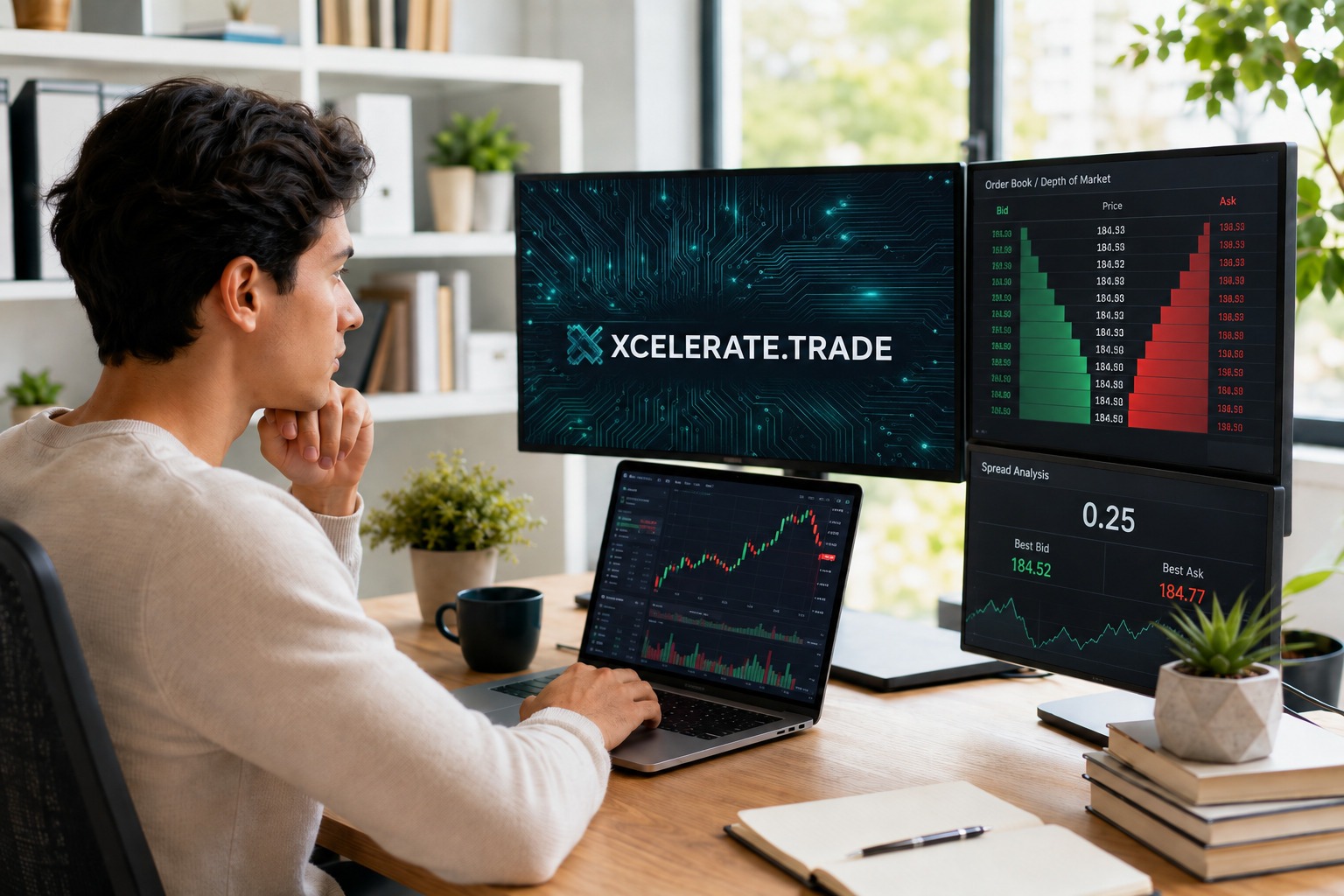

If I had to give a beginner one clear answer, I would start with stock indices. I would choose one major index, learn its rhythm on a demo account, and resist the urge to jump between five different markets every day. For many people that first index will be the S&P 500, while a trader living on a European schedule may find DAX/GER40 more practical.
That answer sounds almost too simple when the Xcelerate Trade ecosystem gives you access to a much wider financial world. You can study indices, gold, currencies, individual stocks, cryptocurrencies and other instruments, each with its own appeal. The temptation is to think that a serious trader should understand all of them from the beginning.
I do not think that is how most people learn well. When I am trying to understand a new skill, I want fewer variables, not more. Trading becomes difficult enough once real uncertainty, risk and emotion enter the picture.
A beginner does not need the market with the biggest candles or the loudest online community. A beginner needs a market that can be watched consistently, studied patiently and understood well enough for patterns in personal behavior to become visible. That is why stock indices make such a sensible starting point inside Xcelerate.Trade.
The Short Answer: Start With One Major Stock Index
My first choice would usually be the S&P 500 if the trader can comfortably follow the US session. It gives broad exposure to the American equity market, has deep participation and offers enough movement for intraday study without forcing a beginner to start with the fastest instrument available.
If the trader lives in Europe and has more time during the European morning, DAX/GER40 can make more practical sense. Schedule matters more than beginners sometimes expect, because a good market at a bad hour can quickly become a bad learning environment.
Nasdaq 100 would also be on my shortlist, but I would usually approach it after building some discipline. It tends to move faster than the S&P 500, and speed has a way of exposing weak risk management immediately.
Gold is another strong market within the Xcelerate Trade learning environment. I would generally add it after the beginner has become comfortable with one index rather than trying to study both from the first morning.
So the real recommendation is fairly narrow. Start with stock indices, choose one instrument that fits your daily schedule, practice it on demo, and stay with it long enough to recognize what normal behavior looks like.
Why the First Market Matters So Much
The first market is more than a symbol on a chart. It becomes the place where you learn what volatility feels like, how you react to a losing trade, what happens when economic news arrives, how long you can actually wait and whether your written rules survive contact with a live market.
Those lessons are easy to underestimate when you are new. At the beginning, the entire experience often seems to revolve around finding a good entry. I used to think that finding the entry was the difficult part too, until I noticed how many other decisions surround it.
You need to know when you are allowed to trade, how much you are prepared to lose, where the trade is invalidated and whether the market is behaving normally for that time of day. Then you still need to accept that a perfectly reasonable setup can fail.
Learning all of that while switching constantly between indices, gold, Forex and crypto makes the job harder than it needs to be. Each instrument has a different personality, and the beginner ends up learning fragments instead of building familiarity.
This is one reason I prefer concentration early on. Familiarity does not make the market predictable, but it makes ordinary behavior easier to recognize.
More Markets Do Not Automatically Mean More Opportunity
Open a trading platform and the amount of choice can feel almost intoxicating. One chart is moving slowly, another is exploding upward, gold has reacted to a data release and Bitcoin seems to be doing something interesting at the same time.
It is very easy to mistake that movement for opportunity. I have found that sometimes it is simply movement.
A beginner who watches ten instruments can spend an entire session feeling busy without learning very much. The mind keeps resetting every time the chart changes because the context changes too.
That matters more than it seems. A pullback on Nasdaq may feel very different from a pullback on the S&P 500, and a gold reaction around an inflation release can behave differently from an ordinary morning move in DAX.
When everything is new, everything competes for attention. I would rather have one chart become slightly boring than have six charts remain permanently unfamiliar.
Boredom is not always the enemy in trading. Sometimes boredom is the beginning of pattern recognition.
Why Stock Indices Make Sense for a Beginner
I like stock indices as a first market because they let a beginner study broad market behavior without becoming immediately dependent on the story of one company. An index reflects the combined movement of a group of businesses rather than the fate of a single corporate name.
That difference simplifies the learning environment. A single stock can react violently to earnings, management guidance, a lawsuit, a product announcement or an analyst downgrade. An index can certainly move sharply too, but company specific surprises are diluted across a wider basket.
This does not make indices safe. I would be careful with that word anywhere in trading.
Economic releases, central bank decisions, geopolitical events and sudden changes in investor sentiment can move an index quickly. What indices offer is a different structure of risk, not an absence of risk.
For a beginner, I prefer that structure because the educational focus can stay on price behavior, market structure, session timing and risk management. Those are already enough subjects to keep a notebook busy.
Why the S&P 500 Is My Default Starting Point
If somebody asked me to choose one market for a beginner without telling me anything else about that person’s schedule or temperament, I would probably choose the S&P 500.
Part of the reason is its breadth. The index represents a large cross section of major US companies across several sectors, which makes it one of the central reference points for the American equity market.
That gives the beginner useful context. Inflation data, employment reports, changes in interest rate expectations and shifts in investor confidence often feed directly into the broader conversation surrounding the S&P 500.
I also like that the market can teach patience. It moves enough to create intraday opportunities, but a beginner does not necessarily need to begin with the more aggressive character often associated with Nasdaq 100.
Of course, there are days when the S&P 500 moves quickly. There are also sessions that feel slow, awkward or directionless.
I consider those days part of the education. The beginner needs to learn that a market is not required to provide an attractive setup simply because the trading platform is open.
The S&P 500 Is a Classroom, Not a Shortcut
I want to be careful here because recommending a market can easily sound like promising an easier route. That is not what I mean.
The S&P 500 is not easier in the sense that profits become automatic. It is easier to organize around because it is widely followed, liquid and connected to economic themes that can be studied repeatedly.
There will still be false breakouts. There will still be trades that look reasonable and fail five minutes later.
There will also be days when the best decision is to stay flat. Learning to accept that is worth more than memorizing another entry pattern.
When I call the S&P 500 a good first market, I am really saying that it gives a beginner a useful environment in which to develop routines. The advantage is not hidden inside the index itself.
The advantage comes from watching the same instrument long enough that your own mistakes stop hiding behind unfamiliarity.
When DAX/GER40 May Be the Better Choice
Geography changes the answer.
If you live in Europe and can trade comfortably during the European morning, DAX/GER40 deserves serious attention as a first instrument. It fits naturally into a schedule that may be much easier to maintain than waiting for the American session.
I have always thought that trading advice becomes strangely unrealistic when it ignores ordinary life. People have jobs, families, commutes, school runs and mornings when the coffee goes cold because something else needs attention.
The market has to fit into that life somehow. If your routine forces you to trade at a time when you are tired, rushed or distracted, even a technically attractive instrument may be the wrong first choice.
For that reason, I might choose DAX over the S&P 500 for someone who can consistently study European hours. Consistency outside the market helps create consistency inside the market.
That sounds almost mundane, but trading is full of mundane things that become expensive when ignored.
Schedule Is Part of Risk Management
People usually think about risk management in terms of stop losses and position size. I think schedule belongs in the same conversation.
A tired trader is a different trader. A trader checking a chart between meetings is also a different trader.
If you can only watch the US market while preparing dinner, answering work messages and trying to concentrate on three things at once, your execution is being shaped by more than price action.
A market that fits naturally into your day removes one unnecessary source of pressure. You can watch the session properly, journal the trade and close the platform without feeling as though trading has swallowed the rest of the evening.
That is another reason there is no single perfect index for every beginner. The best first market is partly a market decision and partly a lifestyle decision.
Why Nasdaq 100 Is Tempting
Nasdaq 100 has an obvious attraction. It moves.
When you are new, movement looks like possibility. A fast candle can create the impression that money is available right now and that hesitation means missing the chance.
That feeling is dangerous because the speed of the market starts dictating the speed of your thinking. You see price accelerating and suddenly your carefully written plan feels too slow.
Nasdaq can be an excellent market. I am not trying to scare anybody away from it.
I simply think its generally faster character makes it a better first market for some personalities than for others. A person who is naturally impulsive may find that Nasdaq amplifies exactly the habit that needs to be controlled.
The same volatility that creates an attractive move can also make poor entries, oversized positions and emotional chasing more painful.
I Would Add Nasdaq After the Process Feels Boring
There is a point in learning when the basic routine begins to feel almost repetitive. You check the calendar, mark the relevant levels, define your trading window, wait for the setup and record what happened.
That repetition is useful.
If a beginner can follow that process consistently on the S&P 500 or DAX, then moving to Nasdaq becomes far more interesting educationally. The trader can compare how the same ideas behave in a faster environment.
Now the additional volatility teaches something instead of merely creating excitement.
I would much rather make that transition after risk management feels ordinary. When stop placement and position sizing have become habits, faster movement becomes easier to observe without immediately reacting to every candle.
Where Gold Fits Into the Xcelerate Trade Ecosystem
Gold deserves its own place in the conversation because it sits naturally beside the major indices in the Xcelerate Trade educational framework.
It is one of the world’s most closely followed financial markets and can react strongly to changes in interest rate expectations, the US dollar, inflation concerns and shifts in risk sentiment. That macroeconomic connection makes gold fascinating to study.
It also gives beginners another lesson very quickly. A quiet market can change character within seconds.
Major economic releases can produce abrupt movement, wider spreads and sudden reversals. A chart that seemed perfectly calm a moment earlier may become difficult to execute cleanly.
This is why I usually see gold as a strong second market rather than the first chart a complete beginner should master. I want basic execution to feel familiar before adding a market that can become very fast around news.
Gold Can Teach Respect for Economic News
Gold is particularly good at reminding traders that technical analysis does not happen in a vacuum.
A technically attractive setup may appear just before a major inflation report or central bank announcement. The chart can look clean while the risk is actually changing underneath it.
This is where the economic calendar becomes part of normal preparation rather than something checked after a surprising loss.
I would build that habit early whether the beginner trades gold or stock indices. Knowing when major economic information is scheduled is a basic part of understanding the environment in which the trade is being taken.
You do not need to become an economist. You do need to know when the market may suddenly become more sensitive than usual.
Why I Would Not Begin With Forex Inside This Learning Path
Forex is one of the largest and most liquid financial markets in the world. There is nothing inherently wrong with learning it first.
My hesitation is more practical. Currency pairs ask the beginner to think in relationships.
If you trade EUR/USD, you are dealing with the relative value of two currencies. That relationship can be influenced by monetary policy, interest rate expectations, inflation, economic growth and political developments on both sides of the pair.
That is interesting once you have a framework. It is a lot to absorb while you are still learning how not to move a stop loss because a candle made you uncomfortable.
Inside the Xcelerate Trade approach, I therefore find the emphasis on indices and precious metals more suitable for the early stages. Forex can come later as a specialization rather than becoming another layer of complexity on day one.
Individual Stocks Add a Different Type of Noise
Beginners often feel comfortable with individual stocks because they recognize the companies. Apple, Nvidia, Tesla or Microsoft are names people hear outside financial markets.
That familiarity can be misleading.
Knowing the product does not mean you understand how the stock behaves around earnings, guidance, analyst revisions or company specific news. A single headline can change the short term picture very quickly.
An index spreads that company specific risk across many constituents. A single stock concentrates it.
There are traders who specialize successfully in individual equities. I simply would not make that my default starting point for somebody whose main goal is to learn the fundamentals of intraday execution.
One less source of uncertainty is useful when everything else still feels new.
Crypto Is Accessible, but Accessibility Can Become a Trap
Cryptocurrency has introduced a huge number of people to trading. The market is easy to access, culturally familiar and active beyond the traditional stock market schedule.
That constant availability can be a problem for beginners.
When a market is always open, it becomes very easy to feel that you should always be watching. The boundaries between trading, studying and ordinary life start disappearing.
A beginner who has not yet learned when to stop can treat continuous access as continuous opportunity.
I would rather develop a structured routine in a market with clearer sessions first. Once the trader understands when to engage and when to close the platform, a twenty four hour market becomes easier to handle without turning into a twenty four hour habit.
Before Trading Anything, Decide What You Are Actually Doing
One of the messiest problems I see among beginners is the confusion between trading and investing.
A person buys an instrument expecting a short term move. The trade goes against them, and suddenly the explanation changes.
What was supposed to last an hour becomes something they plan to hold for months because closing the position would mean accepting a loss.
That is not a change in investment philosophy. It is a trade that lost its rules.
This is why I would understand The Difference Between Trading and Investing before deciding which market deserves serious attention.
The same underlying asset can be used for very different financial objectives. A person might trade an equity index intraday while also maintaining long term exposure to equities elsewhere.
The important part is knowing which activity you are engaged in before capital is at risk.
Trading and Investing Need Different Mental Clocks
Time changes the meaning of a market decision.
An investor may care about business growth, valuation, earnings power and long term economic trends. A short term trader may care far more about current liquidity, market structure, volatility and nearby levels.
Mix those time horizons and decisions become muddy.
A temporary intraday move suddenly feels important to a long term thesis, or a long term belief about an economy becomes an excuse for ignoring a failed short term trade.
I like separating those mental accounts clearly. It keeps the reason for entering a position from changing after the outcome becomes uncomfortable.
Your First Goal Should Not Be Making Money
This is the part beginners rarely enjoy hearing.
I would not make profit the main objective during the first stage. I would make repeatable execution the objective.
Profit is too noisy over a small number of trades. A beginner can make money through poor decisions and lose money while correctly following a reasonable process.
If you judge yourself only by the account balance, you can accidentally reward bad behavior. A lucky oversized trade may feel like proof that the method works.
What I want to know instead is whether the setup was valid, whether the risk was defined before entry and whether the trade was managed according to the plan.
Those questions are less exciting. They are also much more useful.
Demo Trading Should Be Treated Like Practice, Not Entertainment
A demo account is valuable when it is used seriously.
I would trade the same hours I expect to trade later. I would use realistic position sizes and record the same information I would care about if real money were involved.
What I would not do is place huge virtual trades simply because the losses are not real. That teaches a habit I would later need to unlearn.
Demo trading cannot reproduce every emotional reaction created by real money. A simulated loss and a real financial loss do not feel identical.
Still, demo practice can reveal a surprising amount about impatience, overtrading and poor preparation. You do not need real money on the line to notice that you entered three trades because you were bored.
One Market Gives Your Journal Meaning
A journal becomes much more useful when the observations belong to a consistent environment.
Suppose you record twenty trades spread across gold, Bitcoin, Nasdaq, DAX, EUR/USD and individual stocks. You have twenty experiences, but very little repetition.
Now imagine twenty trades taken on the same index, during the same general trading window, using the same setup.
The information becomes much easier to compare.
You may notice that your entries are consistently early. You may discover that the setup performs differently around major economic releases or that your worst trades tend to happen late in the session.
Patterns in your own behavior become visible because the market itself is no longer changing every few trades.
Familiarity Is Not Prediction
I want to draw a line here because familiarity can easily become overconfidence.
Watching one market every day does not mean you know what it will do next. The market owes you nothing because you recognize yesterday’s structure.
Familiarity is useful for a different reason. It teaches you what ordinary behavior looks like.
You begin to notice how active different parts of the session tend to be. You recognize when volatility seems unusually high and when a pullback is still behaving within a familiar range.
This does not remove uncertainty. It gives uncertainty context.
That is a much healthier form of confidence.
Risk Management Matters More Than the Market Name
A common question is whether one index is safer than another. I understand why people ask it, but the question can become misleading.
A relatively calm market traded with excessive leverage can be extremely dangerous. A volatile market traded with controlled position size can produce a much smaller financial risk.
The instrument does not decide how much of your account is exposed. You do.
That is why I would never choose a beginner market by searching for something safe. I would choose an environment in which learning risk management is straightforward.
The S&P 500, DAX and later Nasdaq can all serve that purpose when position sizing, stop placement and daily loss limits are treated seriously.
Stop Loss Placement Should Come From the Trade Idea
One mistake beginners make is deciding how much money they want to risk and then placing the stop at an arbitrary distance.
I prefer to reverse the thinking.
First I want to know where the trade idea becomes invalid. Then I can calculate whether the position size required to keep the financial risk acceptable makes sense.
That small change keeps the chart logic separate from the desire to make a certain amount of money.
It also helps when comparing markets. Nasdaq may require a different stop distance from the S&P 500 because its movement can be more aggressive.
The financial risk can still remain controlled by adjusting position size.
This is another reason learning one market first is useful. You begin developing a realistic sense of how much room normal price movement often requires.
Economic News Can Change the Character of Any Market
Even a familiar instrument can behave very differently around major economic releases.
Inflation data, employment figures and central bank decisions can change expectations about interest rates and growth within seconds. That can affect US indices and gold particularly strongly.
I would check the economic calendar before the trading session as routinely as I check the chart.
There is something unpleasant about discovering after a loss that a major release happened exactly when you entered. Most traders only need that lesson once, though some of us are stubborn enough to need it twice.
The point is not to predict the announcement perfectly. The point is to know when normal assumptions about volatility may stop being useful.
The Best Market Is Also the One You Can Ignore
This sounds strange, but I think it matters.
A healthy trading routine includes time when you are not trading. The first market should fit into a schedule that lets you close the platform and return to ordinary life.
If you find yourself checking prices every few minutes because the instrument trades around the clock, the problem may not be the strategy yet. The problem may be the environment.
A structured index session naturally creates boundaries.
Those boundaries help beginners learn something that charts rarely teach directly: doing nothing is also a trading decision.
When Should You Add a Second Market?
I would add a second instrument when the first one feels understandable, not merely when it feels boring.
If I can describe my setup clearly, follow my risk rules and review a meaningful group of trades without constantly changing the process, I have a reasonable foundation.
Then a second market can teach comparison.
Perhaps I add gold to understand a different response to macroeconomic news. Perhaps I move from the S&P 500 to Nasdaq to study the same structural ideas in a faster environment.
The second market should expand my understanding. It should not simply double the number of charts available when I feel impatient.
Do Not Change Markets Because of a Bad Week
This is one habit I would try hard to avoid.
A few losing trades can make another market look attractive. Suddenly gold seems cleaner, Nasdaq seems easier or somebody online appears to have discovered a better instrument.
The temptation is understandable.
The problem is that changing markets constantly prevents you from collecting enough evidence to know whether the original problem came from the instrument, the strategy or your execution.
Markets go through different conditions. A strategy that feels comfortable one week may produce awkward setups the next.
I would give the process enough time to create a meaningful sample before drawing conclusions.
The Beginner’s Real Advantage Is Simplicity
Beginners often assume that experienced traders know more indicators, more markets and more setups.
Some do.
What experience often creates, however, is the ability to remove things.
A trader gradually learns which information matters and which information merely creates noise. The screen may become simpler as the thinking becomes more sophisticated.
For a beginner, I would borrow that simplicity early.
One primary market, one trading window, one clearly defined setup and one risk framework are enough to learn a great deal.
You can complicate things later. Financial markets will still be there.
How I Would Make the Choice in Practice
If I were starting inside Xcelerate Trade today, I would begin by looking at my schedule before looking at the chart.
If the US session fits comfortably into my day, the S&P 500 would probably be my first choice. I would study it on demo until normal session behavior, major news reactions and my own execution mistakes started to look familiar.
If I had a reliable European morning instead, I would take DAX/GER40 seriously. The practical ability to study consistently matters more to me than choosing the most famous index.
If I already had strong discipline and preferred a faster market, Nasdaq 100 might become the first instrument. I would still keep the position sizing conservative while learning its movement.
Gold would remain nearby, but I would usually add it later.
That is not a universal ranking. It is a learning sequence.
How Xcelerate.Trade Fits Into That Learning Sequence
I see the Xcelerate.Trade ecosystem as most useful when it is approached in stages.
Education comes first because vocabulary and basic concepts matter. Demo practice comes next because knowledge needs to be tested against live price movement without immediately introducing unnecessary financial pressure.
After that, tools and more advanced approaches become easier to evaluate.
The sequence matters because technology cannot repair weak habits. A better indicator does not make an impulsive trader patient.
A more advanced platform does not automatically create better risk management either.
Tools become useful when the person using them already understands the decision they are trying to improve.
What Progress Actually Looks Like
The first signs of progress are often rather quiet.
You stop entering a trade simply because price moved quickly. You begin checking major economic events before the session.
You accept that missing a move is cheaper than chasing it.
Your journal starts showing fewer emotional explanations and more specific observations. Instead of writing that the market was strange, you notice that you entered before confirmation or traded during a period you had already decided to avoid.
Those changes are harder to show on social media than a large winning trade.
I trust them more.
Why S&P 500 Is Still My First Recommendation
After comparing the main choices, I keep returning to the S&P 500 for the average beginner.
It offers a broad view of the US equity market, strong participation and enough intraday activity to study without requiring a beginner to begin with the most aggressive pace available.
It also gives the trader access to an enormous amount of economic context. Over time, you can learn how inflation expectations, employment data, interest rates and investor sentiment influence broader equity behavior.
That relationship between chart and economy becomes educational even when you do not take a trade.
Most importantly, the market is deep enough to remain relevant after the beginner stage. You are not learning a temporary instrument that needs to be abandoned once your skills improve.
When DAX Would Replace the S&P 500 as My First Choice
I would make one important exception.
If the trader’s schedule strongly favors the European session, I would probably choose DAX/GER40 rather than forcing the S&P 500 into an inconvenient afternoon routine.
The ability to trade consistently while alert is a real advantage.
Someone who can study DAX every weekday morning may learn faster than someone trying to watch the S&P 500 intermittently while working.
That is why I would never treat market selection as a purely technical question.
Your daily life is part of the strategy whether the chart knows it or not.
Where Nasdaq Belongs
Nasdaq 100 remains one of the most attractive indices for intraday traders because of its movement.
I simply prefer to earn that volatility.
By that I mean I want basic risk habits to be stable before I intentionally move toward a faster environment.
Once the trader can wait, size positions properly and accept a stopped trade without immediately trying to recover the money, Nasdaq becomes much more interesting.
Before that point, speed can become a teacher with expensive tuition.
Where Gold Belongs
Gold is the second market I would study most seriously after a major index.
It adds a different relationship with macroeconomic events and can teach the trader a great deal about volatility around important news.
It also prevents the learning process from becoming too narrow once the first market is understood.
I would still avoid alternating randomly between gold and indices from the beginning. There is more value in learning them sequentially.
First familiarity, then comparison.
The Market Does Not Fix the Trader
Eventually every beginner discovers that choosing the market was the easy decision.
The S&P 500 cannot make you patient. DAX cannot stop you from entering because you are bored.
Nasdaq cannot control your position size, and gold cannot force you to check the economic calendar.
The chart simply reveals the quality of the decisions being made around it.
This is why I see market selection as the beginning of the process, not the solution.
A good first market reduces unnecessary complexity. What you do with that simplicity is still up to you.
My Final Choice for a Beginner in the Xcelerate Trade Ecosystem
For a beginner entering the Xcelerate Trade ecosystem, I would choose the stock index market first.
My default instrument would be the S&P 500 for someone who can trade the US session consistently. For a trader whose daily life fits European hours better, I would seriously consider DAX/GER40 instead.
I would move toward Nasdaq 100 after basic execution and risk management feel stable. Gold would be a natural second market once the beginner understands how one index behaves across ordinary sessions and major economic events.
I would leave Forex, individual equities and crypto for later unless there is a specific reason to specialize in them from the start.
The goal is not to find the market that promises the most action. The goal is to find a market you can study long enough for your own behavior to become visible.
That is the part beginners sometimes miss.
You are learning the chart, yes, but you are also learning the person sitting in front of it.
A few months later, the chart may still look almost the same. The difference is that your hand no longer reaches for the mouse every time a candle moves.
Frequently Asked Questions
Which market should a beginner choose first in Xcelerate Trade?
For most beginners, I would start with a major stock index. The S&P 500 is my default choice when US trading hours fit the person’s schedule, while DAX/GER40 may be more practical for someone who can trade consistently during the European session.
The reason is not that these markets are easy or safe. They simply provide a focused environment in which a beginner can study liquidity, volatility, session behavior, economic news and risk management without adding too many variables at once.
Is the S&P 500 good for beginner traders?
I think the S&P 500 is one of the most practical markets a beginner can study. It represents a broad section of the US equity market and is influenced by major economic themes that are relatively easy to follow over time.
It still carries significant risk, especially around important economic announcements. Its main advantage for a beginner is that it offers a deep, widely followed market in which a consistent routine can be developed.
Is DAX/GER40 better than the S&P 500 for European traders?
It can be. If a trader lives in Europe and has reliable time available during the European morning, DAX/GER40 may fit daily life better than waiting for the main US trading hours.
I would choose the market that allows consistent study while the trader is alert and free from unnecessary distractions. Schedule is often more important than trying to decide which index is theoretically superior.
Should a beginner trade Nasdaq 100?
A beginner can trade Nasdaq 100, but I would approach it carefully because its faster movement can magnify execution mistakes. The volatility is attractive when risk management is already disciplined, but it can encourage chasing and impulsive decisions when those habits are still developing.
For that reason, I often prefer to learn the basic process on the S&P 500 or DAX first. Nasdaq can then become a useful second index once the trader is comfortable with stop placement, position sizing and waiting for valid setups.
Is gold suitable for beginner traders?
Gold can be suitable for beginners, particularly within a structured educational environment, but I usually prefer it as a second market. Gold can react sharply to inflation data, interest rate expectations, the US dollar and central bank decisions.
A beginner who already understands basic execution and economic calendar awareness will usually get more educational value from gold than someone who is still learning several fundamental trading concepts at the same time.
Should beginners start with Forex or stock indices?
My preference inside the Xcelerate Trade learning path is stock indices. Forex involves relative relationships between two currencies, which means the trader may need to understand economic and monetary forces affecting both sides of the currency pair.
That does not make Forex a bad market. It simply adds another layer of interpretation that may be easier to handle after basic trading skills are established.
How many markets should a beginner trade at the same time?
I would begin with one primary market. A second instrument can be added after the trader has accumulated enough demo experience to recognize common behavior, follow a written process and review a meaningful sample of trades.
Trying to follow too many markets early on often creates activity without familiarity. One well studied market can teach more than a large watchlist that changes every day.
Should a beginner use a demo account before trading real money?
Yes, I would. Demo trading provides a practical environment for learning order execution, stop placement, position sizing and session routines without immediately putting capital at risk.
It does not perfectly reproduce the emotional pressure of trading real money. Even so, it is an effective place to identify basic mistakes before those mistakes become financially expensive.
How long should a beginner stay with one market?
I would stay with one market until there is enough repetition to evaluate the process rather than isolated outcomes. That usually means building a meaningful trading journal and seeing the same setup across different market conditions.
I would not switch simply because of a few losing trades or a quiet week. The point is to remain long enough to distinguish a problem with the strategy from a problem with execution.
What is the easiest market to trade for beginners?
I would avoid calling any financial market easy. Every market can produce losses, unexpected volatility and periods when familiar setups stop behaving as expected.
A better question is which market offers a manageable learning environment. For many beginners inside Xcelerate.Trade, a major stock index such as the S&P 500 or DAX/GER40 is a practical answer.
What should a beginner focus on before trying to make money?
I would focus first on consistency of execution. That means understanding the setup, defining risk before entry, respecting the trading window and recording what happened afterward.
Profit matters eventually, of course. Early in the process, however, repeatable behavior tells you far more about whether you are actually developing a skill.
Can a beginner trade more than one market in Xcelerate.Trade?
Yes, but I would expand gradually. Once the first market becomes familiar and the trading process is stable, adding a second instrument can help you compare volatility, session behavior and reactions to economic events.
I would make the second market a deliberate learning choice rather than simply another place to look for action. That keeps expansion from turning into overtrading.