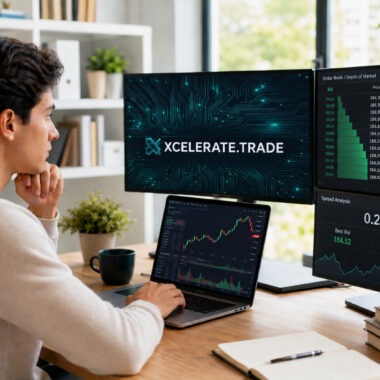

At 3:59 in the afternoon, New York time, a day trader and a long-term investor want opposite things from the next sixty seconds. One is scrambling to be out of every position before the closing bell. The other probably hasn’t opened the brokerage app since spring.
Xcelerate Trade teaches that day trading and investing chase the same goal, growing capital through the markets, but they run on very different clocks and ask for a different relationship with risk. Its Academy trains intraday trading on stock indices and gold, and treats long-term investing as a separate pillar that many professionals keep running next to their trading.
I went through the Academy’s lesson map with exactly that question in mind, mostly because I keep hearing the two words used as if they meant the same thing. Most chapters stay locked until you pass the quizzes, so for those I’m working from the official lesson summaries rather than the full text. The position still comes through clearly. It’s also more balanced than I expected from a platform built around day trading.
What follows is my reading of it, with a bit of history and a couple of numbers that people selling the trading dream tend to leave out.
Same Goal, Different Time Horizons
The core idea in Xcelerate Trade’s material is that trading and investing aim at the same result, a bigger pool of capital, and differ mainly in time horizon, risk and mindset. One early lesson is literally titled “Long-Term Investing and Trading: Two Different Approaches, One Common Goal,” which tells you where the emphasis sits.
An investor measures progress in years. They buy a slice of a business, or more often an index fund holding hundreds of businesses, and let earnings growth and reinvested dividends do the slow work. Checking the price every hour adds nothing. For plenty of people it actively makes things worse.
A day trader measures progress in sessions. Every position opens and closes inside the same trading day, so the result depends entirely on how price moves over minutes or hours. The company behind the chart barely matters to the trade. What matters is whether the setup you trained for shows up, and whether you execute it the way you planned.
What You Actually Own
This is the part beginners skip, and I understand why, because it sounds like a technicality. Someone who buys an exchange-traded fund (ETF) tracking the S&P 500 owns units of a fund that holds real shares of real companies. A day trader working the Nasdaq 100 through a contract for difference (CFD) or a futures contract owns nothing except exposure to price, usually with leverage attached.
That single difference shapes almost everything downstream. Ownership lets you sit through a bad year and wait, since the companies keep operating whether you watch them or not. A leveraged contract offers no such patience. A sharp move can close the position long before the market “comes back.”
Where the Return Is Supposed to Come From
Investors get paid, in theory, for providing capital to productive businesses over long stretches of time. The return arrives slowly and unevenly, but it doesn’t depend on out-thinking whoever sits on the other side of each trade.
Day traders get paid only if they have an edge. The curriculum tackles this head on in a lesson called “Gambling vs. Trading,” which argues that a casino’s mathematical edge belongs to the house and can’t be changed, while a trader tries to build a statistical edge of their own through analysis and consistently applied rules. I like the framing because it cuts both ways. Without a real, tested edge, frequent trading drifts toward the casino side of the room.
Why Xcelerate Trade Academy Teaches Intraday Trading
The Xcelerate.Trade Academy focuses on intraday trading because it wants beginners to master one repeatable process in a handful of liquid markets rather than sample every style. The chapter on trading styles walks through intraday, swing, scalping and fundamental approaches before explaining why the curriculum settles on the first.
The choice of markets is just as deliberate. According to the lessons, the course doesn’t trade “everything that moves” and prefers stock indices such as the S&P 500, the Nasdaq 100 and Germany’s DAX 40 (quoted as GER40 on many platforms), along with gold, because of their liquidity and cleaner intraday structure. Forex gets a respectful mention but is described as a harder first choice, with too many forces pulling at once. Beginners are told to start with one or two instruments on a demo account and learn how those behave.
Anyone coming over from the investing side should underline this bit. An investor benefits from breadth, owning so many things that no single mistake matters much. A day trader, at least in this framework, benefits from the opposite: knowing one or two instruments so well that their daily rhythm starts to feel familiar.
Five-Minute Context, One-Minute Execution
The time scale alone shows how far this sits from investing. According to the lesson on timeframes, the course mainly uses the 5-minute chart for context and structure and the 1-minute chart for entries, with TradingView set to New York time. An investor might glance at a monthly chart once a quarter and still be doing the job properly.
None of this makes one approach superior. The skills just barely overlap. Reading a balance sheet won’t help you time a 1-minute entry, and a flawless intraday checklist says nothing about whether a company will still be growing in 2035.
Flat Before the Bell
Closing everything within the session is what defines day trading, and it comes with a real advantage. Overnight gaps, the jumps between one close and the next open after an earnings report or a political headline, can’t hurt a position that no longer exists. The investor accepts gap risk as the price of ownership. The day trader gives it up, and in exchange has to be right again and again inside a few hours.
How Risk Is Measured in Day Trading Versus Investing
For an investor, risk mostly means a drawdown lasting months or years and the temptation to sell near the bottom. For a day trader in the Xcelerate Trade framework, risk is a number fixed before every single trade, and that number is small by design. The risk management lessons suggest thinking in account percentages, with guidelines between 0.25% and 1% per trade, and sizing the position so the distance to the stop loss matches that planned loss.
Round numbers make it easier to picture. On a €10,000 account, risking 0.5% means €50. If the structural stop sits 25 points away, the position gets sized so those 25 points cost exactly €50, and the stop never gets pushed further out to “give the trade room.”
The lessons also describe a Three Losses Rule, a behavioral stop after three losing trades. The summary is careful to say this isn’t because the fourth trade is doomed. Three losses in a row simply tend to change how people execute, and anyone who has been there knows the feeling.
Investors rarely think in these terms, and mostly they don’t need to. For someone holding a diversified index fund, the main risk control is time plus the discipline not to panic. Time has limits too, though. The Nasdaq Composite needed about fifteen years, from its March 2000 peak until 2015, to climb back to where it had been.
The Drawdown Math Doesn’t Care About Your Style
Losses compound against you in a way that surprises people the first time they run the numbers. Lose 20% and you need a 25% gain just to break even. Lose 50% and you need 100%, which is why both camps, each in its own way, obsess over avoiding the one big hit.
Leverage Changes the Whole Conversation
Leverage is where day trading and investing part ways most sharply. Most long-term investors use none, while intraday trading on indices and gold usually runs through leveraged products. In the European Union, the European Securities and Markets Authority (ESMA) capped retail CFD leverage in 2018 at 20:1 for major indices and gold and 30:1 for major currency pairs, after national regulators found that 74% to 89% of retail CFD accounts typically lost money.
At 20:1, €1,000 of margin controls roughly €20,000 of exposure. A 1% move against you costs €200, a fifth of the money you put up, and indices can move 1% before lunch. No wonder the course puts risk definition and position sizing ahead of any talk about profit.
What Research Says About Frequent Trading and Day Trading Results
Research on frequent trading keeps finding that the most active retail traders underperform, and that most persistent day traders lose money. I think any serious education platform should say so up front. Two studies come up again and again, and every beginner should know them before opening a live account.
The first is a 2000 paper in the Journal of Finance by Brad Barber and Terrance Odean, titled “Trading Is Hazardous to Your Wealth.” Looking at 66,465 households at a large US discount broker between 1991 and 1996, the authors found that the most active traders earned an annual return of 11.4%, while the market returned 17.9%. Before costs, the frequent traders did about as well as everyone else. Trading costs and overconfidence ate the difference.
The second sits much closer to day trading. Economists Fernando Chague, Rodrigo De-Losso and Bruno Giovannetti followed 19,646 people who began day trading Brazilian mini-index futures between 2013 and 2015. Of the 1,551 who kept at it for more than 300 sessions, 97% lost money, and only 1.1% earned more than Brazil’s minimum wage.
Grim reading, I know. What I find useful is how the Xcelerate.Trade material deals with that reality. Its lesson on realistic expectations calls trading a business rather than a shortcut to wealth and says early success means following the process instead of chasing quick profits. That doesn’t change the base rate, but at least nobody pretends the base rate is something else.
Win Rate Is Not the Scoreboard
The lessons keep returning to one idea: judge a strategy by expectancy, not by how often it wins. Say you win 40% of your trades and your winners average 2.5 times the size of your losers. Counting R as the amount you risk on each trade, your expectancy is 0.4 times 2.5, minus 0.6 times 1, which works out to 0.4R per trade, positive even though you lose more often than you win.
Investors don’t really have an equivalent, because they aren’t placing hundreds of separate bets. A trader’s results form a statistical sample. An investor’s results are mostly one long exposure to the economy.
A Short History of the Trader and the Investor
The split between trading and investing is far older than any app, and the rules around day trading have changed more over the last thirty years than the psychology has. In 1934, Benjamin Graham and David Dodd used their book Security Analysis to draw a line between an investment, backed by thorough analysis and a reasonable promise of safety and return, and everything else, which they called speculation.
Speculators had their legends long before that. Jesse Livermore learned his craft in the bucket shops of the early 1900s, betting on price ticks without ever owning the stock, and went on to make and lose several fortunes. If that sounds a lot like trading a CFD today, the resemblance is no accident.
Investing got its own revolution in 1976, when John C. Bogle’s Vanguard Group launched the first index fund for ordinary savers. Critics nicknamed it Bogle’s Folly. Today, owning the whole market cheaply is the default advice for most long-term savers, which says a lot about how often stock picking disappoints.
Day trading went retail in the 1990s. Electronic order routing and the so-called SOES bandits, traders who used Nasdaq’s Small Order Execution System to pounce on stale quotes, turned it into a job people quit their jobs for. Then the dot-com crash arrived and wiped many of them out.
The Rule That Lasted a Quarter Century
The regulatory answer to that era was the pattern day trader (PDT) rule. From 2001, anyone making four or more day trades within five business days in a US margin account was generally required to keep at least $25,000 in equity. For a generation of small traders, it was the first wall they hit.
That wall is now coming down. In Regulatory Notice 26-10, the Financial Industry Regulatory Authority (FINRA) explains that the U.S. Securities and Exchange Commission (SEC) approved replacing the old day trading margin requirements with an intraday margin standard, effective June 4, 2026, with brokers allowed to phase it in until October 20, 2027. The $25,000 minimum and the pattern day trader label disappear, and margin is tied instead to the exposure you actually carry during the day. The old rule never applied to futures, forex, crypto or CFD accounts at European brokers in the first place.
I’ll be blunt about what this means. Easier access doesn’t make day trading easier, and it certainly doesn’t change the numbers from Brazil. If anything, losing that financial speed bump makes structured education more important.
The Psychology Gap Between Day Traders and Investors
The biggest practical difference between day trading and investing is how often your emotions get tested. An investor faces a real test once every few years, when a bear market makes selling feel like the only sane option. A day trader gets tested several times before dinner.
The psychology chapter is, to me, the strongest part of the Academy outline. It describes stages many traders pass through, starting with excitement and overconfidence, sliding into fear and doubt, and arriving, for some, at consistency and discipline. It also warns that winning streaks inflate risk just as surely as losing streaks breed fear, something an investor almost never has to manage day to day.
Two lesson titles say a lot on their own: “The Market Owes You Nothing” and “When It Is Better NOT to Trade.” You rarely find lessons like that in investing courses. On a stressful day, an investor’s best move is usually to close the app and go for a walk.
News Filters and Days Off
The news filter is another intraday habit with no real investing equivalent. Beginners are told to check the economic calendar before every session, to sit out days with US Consumer Price Index (CPI) data, Nonfarm Payrolls (NFP) reports or Federal Open Market Committee (FOMC) decisions, and to keep roughly an hour of distance around major speeches. An index fund holder can let those days wash past. A day trader treats them like a minefield.
The broader checklist runs in a fixed order, filters first, then confirmations, then execution, and a session without a valid trade counts as the process working. I love that detail. For many new traders, sitting on their hands feels like failure, when it’s often the most profitable decision of the day.
Why You Don’t Have to Pick Only One
Xcelerate Trade doesn’t ask anyone to give up investing in order to learn day trading, and that’s the part of its teaching I’d most like beginners to hear. The lesson on the difference between the two explicitly covers why many professionals use both together, and the long-term investing lesson describes how the approaches can work side by side to build and preserve capital.
In practice, this looks like two buckets with two rulebooks. Long-term money sits in diversified holdings you don’t trade. Trading capital is a separate, smaller amount you can afford to lose while you learn. The lesson comparing trading with a regular job pushes the same logic further, advising people to keep personal reserves apart from trading capital and to judge any career change on evidence rather than one exceptional month.
I’ve watched people blur those buckets, and it rarely ends well. The retirement ETF slowly turns into the backup for a trade that went wrong, then for a second one. Keeping the two apart sounds boring, and it’s supposed to.
Where Prop Firms Fit In
The lessons also discuss a route that sits somewhere between the two: funded trading through proprietary trading firms, usually called prop firms. Instead of risking your savings, you pay for an evaluation, trade the firm’s capital under strict daily and overall loss limits, and share the profits if you pass. FTMO is the main reference in the course, with Funding Pips mentioned as an alternative.
This works better as a later stage than as a shortcut. The lesson on funded trading warns against “trading the target” and suggests paying for a challenge only once your process is consistent. That’s a sensible filter, because evaluation fees pile up fast when people buy them the way they’d buy lottery tickets.
How the Platform Turns Theory Into Daily Practice
Xcelerate Trade is a trading education platform that pairs a structured Academy with practice tools, a strategy library and a marketplace, and it publishes its material online in English, Romanian, Spanish and French. The Academy is organized into ten chapters and about seventy lessons, with roughly 27 and a half hours of content on the intraday track. A short quiz closes each lesson, and you need the pass score to unlock the next one, so nobody jumps from the introduction straight to entries.
Around the Academy sits the Practice area, with demo trading, replay mode, challenges and prop-style evaluations. Replay is where I’d spend most of my early hours. It lets you run the same session again and again without live candles pushing you around.
The strategy section is where the contrast with investing gets concrete. Among its Day Trading Strategies you’ll find a rules-based Opening Range Breakout that locks the opening range, waits for a breakout backed by volume, and allows an entry only on a retest and rejection with a predefined stop and risk-to-reward. An investment plan, by comparison, might fit in three sentences and involve buying the same fund every month.
The platform also states that its paths are educational, not personalized investment advice, and that it doesn’t execute trades for you. It teaches a process. Whether that process turns profitable depends on months of practice and, frankly, on whether day trading suits the person at the keyboard.
How to Choose Between Day Trading and Investing
Choosing between day trading and investing depends less on which one is “better” and more on your time, your temperament and your capital. Investing asks for patience and very little screen time. Day trading, the way Xcelerate.Trade teaches it, asks for scheduled focus during a specific session and the stomach to follow a written process after a loss.
Time is the part people underestimate. The main US session runs from 9:30 a.m. to 4 p.m. Eastern Time, which for a reader in Central Europe stretches from mid-afternoon into late evening. If your job or your sleep won’t allow regular, focused hours in that window, the honest answer might be investing for now and practicing on replay over the weekend.
Temperament matters just as much. Some people genuinely enjoy the daily loop of setups and journal entries, and they get sharper inside it. Others find it corrosive, and there’s no shame in that. Better to find out on a demo account in month two than in a live account in month eight.
Money comes last, and the course’s own position is that capital isn’t the main barrier, because strategy and discipline weigh more. I agree with that more than I expected to. A small account with tight rules teaches more than a large one traded carelessly, and your long-term investments should never be what pays for the lesson.
Where I Land After Reading the Curriculum
What Xcelerate Trade teaches about day trading and investing comes down to respecting the difference. It doesn’t dress day trading up as investing with better returns, and it doesn’t sneer at buy-and-hold either. It picks one lane for its curriculum, intraday trading on a few liquid markets, and wraps that lane in rules about risk and behavior that an investor would never need.
If I were starting from zero today, I’d keep a simple investment plan running in the background and treat trading as a skill earned slowly, through replay hours and a journal that doesn’t flatter me. The two can live side by side for years. They just shouldn’t share a wallet.
Frequently Asked Questions
Is day trading the same as short-term investing?
No, although the two get mixed up constantly. Short-term investing usually means holding an asset for weeks or months with some view on its value, while day trading closes every position within the same session. The course treats intraday trading as its own style, separate even from swing trading, where positions stay open for days.
Do I still need $25,000 to day trade US stocks in 2026?
Not under the new FINRA framework, which replaced the $25,000 pattern day trader minimum with an intraday margin standard from June 4, 2026. Brokers can phase the change in until October 20, 2027, so yours may keep the old limits for a while. Check your broker’s current policy before assuming the restriction is gone.
Do day traders pay more in costs than long-term investors?
Usually, yes, because costs grow with activity. A day trader pays the spread and any commission on every round trip, often several times a day, and loses a little more to slippage when prices jump around the open or a news release. Closing before the bell does spare them the overnight financing charged on leveraged CFD positions, while an index fund investor mostly pays a small annual fund fee and trades a few times a year.
Is swing trading closer to investing or to day trading?
It sits in between, but in skills and risk it’s much closer to day trading. Swing traders still work from charts with defined stops, and on top of that they carry the overnight gap risk that intraday traders avoid. Most investors hold for years and think about valuation rather than entries.
Is Xcelerate Trade Academy suitable for complete beginners?
The program presents itself as built for beginners and for traders who want a clear, repeatable process, and it starts with core concepts and risk management before any chart work. Quizzes gate each lesson, which slows people down in a useful way. The first lesson is open, the full path requires a membership tier or an $XLR unlock, and everything in it is education rather than personalized investment advice.
How long does it take to learn day trading properly?
The Academy content runs to about 27 and a half hours, but finishing the lessons is the easy part. Building a track record on replay and demo that you actually trust usually takes months. The Brazilian study also found no evidence that time spent day trading automatically turned into profit, so let your journal, not the calendar, tell you when you’re ready.
Is copy trading closer to investing or to trading?
It feels passive, like investing, but the risk underneath belongs to a trader. When you copy someone, you inherit their leverage and their drawdowns, sometimes with slightly worse fills than they get. The Xcelerate.Trade Marketplace lists copy trading, and the sensible way to approach it is to fund it from trading capital, never from long-term savings, and to study a trader’s worst drawdown before their best month.