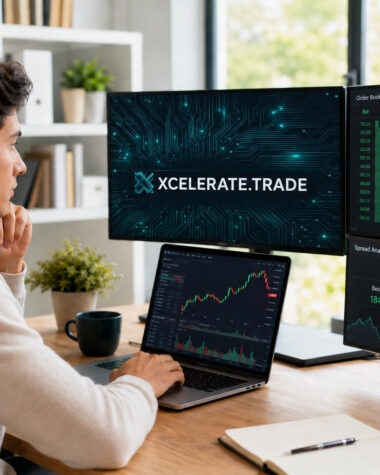

I want to understand what a single price movement could cost me before trusting any futures trading strategy. A chart can make a decision look straightforward, especially when someone has already marked the entry and exit. The harder work is connecting that picture to an actual contract, an account balance, and an order that may behave differently in a fast market.
Xcelerate Trade can help traders understand futures contracts by providing structured lessons, strategy examples, and chart tools that connect market analysis with practical decisions. I would use those resources to study how contract size affects risk, then verify the specifications with the exchange. The platform describes its services as educational, not brokerage or money management.
My approach would be to use the education as a framework, then verify execution rules with the broker, the firm handling orders and the trading account. Observing another trader can add useful context, but I still need to explain the exposure behind the trade. Exposure means the market position whose price changes affect the account. The examples here are hypothetical illustrations, not recommendations or personal trading results.
What does a futures contract commit me to?
CME Group defines a futures contract as a standardized, exchange-traded agreement to buy or sell an asset under specified terms at a future date. Depending on the contract, settlement fulfills the obligation through delivery or a cash payment. The exchange defines the contract’s size and settlement rules, while buyers and sellers determine its traded price.
I find it easier to understand that definition by separating the market opinion from the instrument. A stock index measures the performance of a specified group of stocks, and expecting it to rise is a market opinion. Buying an index futures contract turns that view into exposure measured by a multiplier, the dollar value assigned to each index point. The contract also identifies an expiration month, when trading ends and final settlement takes place under its rules.
Buying a futures contract opens a long position, which generally benefits when that contract’s price rises. Selling to open creates a short position, which generally benefits when its price falls. An opposite transaction in the same contract can close the position before expiration, although the broker’s procedures and deadlines still matter. Holding through settlement introduces obligations that depend on the product.
Give the learning a sensible order
The public Xcelerate.Trade Academy page describes a structured program covering financial markets, capital, risk management, analysis, and trading psychology. That gives a beginner a possible sequence rather than a collection of unrelated tips. I would use the sequence to keep the basic questions ahead of the more exciting ones, while checking the current syllabus and access conditions before paying for anything.
Position sizing means deciding how many contracts to trade, and I would study it before evaluating a breakout setup. A breakout is a price move beyond a defined range or level. Otherwise, it is easy to admire a trade without knowing whether its ordinary losing outcome would be tolerable. A lesson becomes more useful when I can carry one idea into a calculation and see exactly what changes.
I also resist treating course completion as evidence of readiness. Understanding an explanation on a quiet afternoon differs from applying it while prices move and an order needs attention. My test would be whether I can repeat the reasoning without the lesson playing beside me.
Translate ticks and points into money
A tick is the smallest permitted price increment for a particular futures transaction. A point is a unit of the quoted price, which may contain several ticks. Confusing the two can produce a surprisingly large sizing error, so I would learn their monetary values before considering an entry.
CME Group specifies a minimum price increment of 0.25 index points for an outright Micro E-mini S&P 500 futures position, meaning a position in a single contract month. Its value is $1.25 per tick per contract. Four ticks therefore equal one index point, worth $5 per contract, as confirmed by the exchange’s Micro E-mini specifications.
Suppose I buy one of those contracts and its price rises by eight points before I close it. The gross gain is $40, because eight multiplied by $5 equals $40. If the price falls by eight points instead, the gross loss is $40. Commissions, other applicable charges, and differences between expected and actual execution prices affect the net result.
Now suppose I enter five contracts rather than one. The same eight-point move produces a $200 gross gain or loss. Keeping contract quantity beside the example makes that difference visible without changing the price scenario.
Does margin tell me how much I can lose?
Margin is money required to support a futures position, and it does not cap the possible loss. CME Group describes initial margin as the amount required when a position is initiated and maintenance margin as the minimum equity level that must be maintained. Equity means the account’s value after gains and losses are taken into account. Requirements vary with market conditions, so the broker’s current figures need checking before an order is placed.
A position being permitted by the platform does not mean its potential loss fits my finances. I would compare the planned loss with account equity separately from checking the margin requirement. Passing the funding check would not settle the sizing decision for me.
CME Group’s margin FAQ explains the exchange framework, while the broker’s documentation supplies its account-specific requirements. I would check what happens if equity falls below the required level and whether the broker can close positions automatically. That action is liquidation, and its timing can affect the price at which a position ends.
Make leverage visible before judging a result
Notional value is the full market exposure represented by a futures position. For an index futures contract quoted in points, it can be calculated by multiplying the quoted level by the contract’s dollar multiplier. That exposure can be much larger than the margin posted to support it.
For a hypothetical Micro E-mini S&P 500 price of 6,000, the $5 multiplier gives one contract a notional value of $30,000. This is an illustration, not a current market quote. CME Group’s equity futures comparison confirms the multiplier and explains the relationship between quoted price and exposure.
Leverage means taking market exposure larger than the capital committed to support it. It magnifies the effect of price changes relative to that capital. The U.S. Commodity Futures Trading Commission, or CFTC, warns in its customer advisory on virtual currency trading that leveraged futures positions can produce losses exceeding the initial investment.
When I see a percentage return, I want to know what balance and exposure produced it. A large gain on a small margin amount may look impressive while telling me very little about the risk taken. I ask how the same position would behave during an unfavorable move before treating the result as evidence of skill.
Turn a strategy example into a sizing exercise
A sizing exercise connects the distance to an exit with its dollar cost. Suppose a hypothetical entry is 6,000 and the planned stop, an order intended to exit after an adverse move, is 5,994 on one Micro E-mini S&P 500 contract. The six-point distance represents $30 of planned price risk before costs and execution differences. Two contracts would double that figure to $60.
If my chosen risk allowance for that exercise were $50, two contracts would already exceed it before fees. One contract would leave more room, although no stop order makes the final loss certain. If even one contract exceeds an appropriate allowance, I would leave the trade alone or continue studying it in simulation. The minimum tradable size does not have to fit every account.
The planned exit should correspond to the conditions under which the trade idea no longer makes sense, its invalidation point. Moving that exit closer simply to fit a budget changes the strategy being tested. I would reduce quantity or decline the setup rather than make that adjustment without testing it.
After studying a strategy example, I would close it and calculate the proposed trade independently. I would compare my position size and planned exit with the lesson, then investigate any difference. That comparison would show whether I had understood the rule well enough to apply it.
Learn what an order can actually do
A market order seeks execution at available prices, but it does not promise the price visible a moment earlier. A limit order restricts the acceptable execution price, with the possibility that it will not fill. A stop order activates when specified conditions are met, and its subsequent behavior depends on the order type and trading venue. CME Group’s futures order types guide explains these distinctions.
A stop-limit order becomes a limit order when its trigger condition is met, so it can remain unfilled if the market moves beyond the permitted price. Other stop arrangements may execute at a worse price than expected or have exchange-specific protection rules. Slippage is the difference between an expected execution price and the actual fill price. I would check the exact order supported by the broker before relying on it.
Picture a planned exit near a price level during a sharp announcement-driven move. Available buying and selling prices may change before the order fills. When reviewing the example, I would distinguish the intended exit from the actual execution instead of treating the line on the chart as a guaranteed price.
Keep expiration and settlement in the picture
Expiration is the end of a dated futures contract’s trading life, followed by final settlement under its terms. A broker may require an earlier exit, particularly where delivery obligations are involved. I would record the applicable deadline even for a trade intended to last only part of a session.
CME Group’s Micro E-mini expiration guide confirms quarterly expiration and cash settlement for those equity index contracts. Cash settlement means the obligation is resolved financially rather than by delivering the underlying assets. I would check the specifications separately before applying that assumption to an energy or agricultural contract.
Rolling means closing exposure in one contract month and opening it in another. I would treat that as a new transaction with its own execution and costs. The difference between the two months’ prices can also affect what I see on a chart. A continuous historical display may join contracts together without being an instrument I can trade directly.
Why can account equity change while a position stays open?
Mark-to-market is the daily accounting of futures gains and losses using an official settlement price. CME Group explains that the exchange establishes that price under a disclosed methodology, which can differ from the last traded price. A position can therefore affect the account balance before I choose to close it.
An unchanged market opinion does not suspend those funding obligations. If the position moves against the account, I would check the remaining equity and the broker’s requirements rather than assume there is unlimited time to wait. The question is whether the account can support the position through the adverse movement.
For an overnight practice exercise, I would record settlement changes and the equity available to support the position. I would read the broker’s procedure for a funding shortfall alongside those figures. That would let me test the holding plan against the account rules.
Use chart tools to explain a decision
The Xcelerate Trade website describes tools that mark opening ranges and price structure, helping learners examine how a strategy defines an entry. An opening range is the high-to-low price interval during a specified initial part of a trading session. A chart indicator is a visual or numerical calculation applied to market data. I would use it to inspect a rule, without assuming that the tool establishes the strategy’s profitability.
Consider a hypothetical opening-range breakout. Before studying its outcome, I would define the session and time zone used to build the range. I would also specify whether an entry requires a close beyond the range or another condition. Without those definitions, two examples can look similar while representing different rules.
A wider opening range might imply a more distant invalidation point and a larger planned loss for the same quantity. I would calculate that change before comparing the trade with another example. That way, a similar-looking pattern would not hide a different dollar exposure.
What can I learn from a copied futures position?
Copy trading reproduces another trader’s transactions in a follower account under a service’s rules. When researching Futures Copy Trading, I would examine how contract quantities are selected and how exits are handled. The arrangement needs to be clear before I can judge whether the copied exposure fits the follower account.
The Xcelerate.Trade marketplace page presents trader profiles and strategy categories. I would verify current availability and costs, then ask which account connections and follower controls a particular service supports. I would also check whether the listing covers the futures product I intend to study. The marketplace description alone does not confirm those execution details.
A useful observation exercise would reconstruct a hypothetical copied position independently. I would identify the contract, translate the stop distance into money, and compare that exposure with the follower account’s equity. If the numbers do not make sense, the fact that someone else initiated the trade does not resolve the problem. I would keep observation separate from committing money while those questions remain unanswered.
Ask what performance figures leave out
A winning percentage, the share of trades that finish profitably, does not explain the size of a typical loss. Imagine a hypothetical strategy that wins eight trades at $25 each, then loses $250 on one trade. Its $200 in gross gains leaves a $50 net trading loss before costs. I would compare the amounts won and lost before drawing any conclusion from the win rate.
I would also ask how much equity declined before a recovery and whether reported results include open losses. A smooth-looking closed-trade history can miss risk that remained in the account between exits. Increasing quantity after losses can further change the meaning of a recovery. I want to understand those choices before judging the final number.
A short profitable period would leave me with questions about the market conditions it covered. I would compare the strategy’s losing examples with its winning ones, including periods when prices moved sideways. That would help me identify conditions the method handles poorly, rather than assume recent results will continue.
Recognize that follower accounts can behave differently
Two accounts following similar instructions may receive different execution prices. Their balances, permissions, minimum position sizes, and existing exposure can also differ. Even a small delay can matter when a strategy targets a short price movement. I do not assume that a leader’s published outcome describes the follower’s achievable result.
A minimum contract size can prevent a follower account from matching the leader’s exposure proportionally. If the smallest tradable quantity is too large for the account, a percentage-based allocation cannot necessarily solve the problem. Depending on the system, rounding may change the quantity or cause the trade to be skipped. I would ask the provider to demonstrate that behavior numerically.
A follower account might also diverge from the reference account after a disconnection or a manually changed position. I would ask how the provider detects and resolves that mismatch. Those are operational questions for the service concerned, not features I can assume Xcelerate Trade supplies.
Make practice produce evidence
A practice journal records the trading rule and the decision made before the outcome is known. My routine would stay narrow at first, using one contract and one setup, the conditions required for a trade. Alongside the chart, I would calculate the dollar value of the planned stop and the actual simulated exit. I could then compare the decision with its result without relying on memory.
I would include realistic costs and avoid changing the rules halfway through the exercise. If an entry requires information that was unavailable at the time, I would mark the example as invalid. It is easy to find a convincing pattern after the outcome is visible, so the written decision needs to come first.
Xcelerate.Trade’s risk disclosure notes that simulated or backtested results may not reflect live execution and emotional decisions. Backtesting means applying a defined strategy to historical data to assess how it would have behaved. I would use simulation to test understanding and consistency, while keeping its results separate from claims about live performance.
Decide whether the education is helping
Futures education is helping when I can explain a proposed trade and check its financial consequences without following a demonstration. I should be able to name the contract, calculate an adverse move, and explain how the exit order behaves. If one of those explanations fails, I have a specific topic to revisit before considering the trade.
Xcelerate Trade can provide a framework for that work, while exchange specifications and broker documentation supply details that education cannot replace. I would use each source for the question it can actually answer. Completing a lesson would leave me responsible for checking the obligations of the order I place.
Frequently asked questions
What should I do if a course and my broker use different terminology?
I would compare the written definitions before assuming the terms describe the same thing. The broker’s order documentation should explain what its order labels actually trigger. If the behavior remains unclear, I would ask for clarification and keep the exercise in simulation.
How should I study a contract quoted in a different currency?
I would calculate the example in the contract’s currency first and label that currency beside every result. Before applying it to an account funded in another currency, I would check the broker’s conversion method and any charges. I would not assume a dollar result transfers unchanged to a balance shown in euros.
What should I record when I decide not to take a trade?
I would record the reason for skipping it before looking at the eventual result. The note might say that the minimum contract quantity exceeded my allowance or that the entry condition never occurred. A later price move would not, by itself, show that the decision to skip was mistaken.
How can I compare two explanations of the same strategy?
I would rewrite both explanations using the same contract and trading session, with identical cost assumptions. Then I would identify whether their entry or exit conditions differ. If the conditions differ, I would treat them as separate versions instead of combining whichever rules happen to fit the historical example.